Kinds of Meditation, and the Wakeful Mind
In the first post of this series I argued that meditation has a place in Powwow, not as a way of gathering power, but as a way of getting ourselves out of the way so that God can work across an uncluttered bridge. But when I say meditation, what do I actually mean?
Meditation is a term that gets used for a lot of different things. For some, it means emptying the mind. For others, it means thinking carefully over a passage of Scripture. Meditation practices are not all the same; they often have different goals. So in this post I want to draw a simple map of the ground using examples from our own Christian tradition, show what each kind offers the powwower, and then look at the one thing the most helpful of them share: they leave us more awake.
Meditation is above all a quest. The mind seeks to understand the why and how of the Christian life, in order to adhere and respond to what the Lord is asking.
— Catechism of the Catholic Church, §2705
Two questions to ask of any practice
There are many ways to sort meditation. The one I have found most useful asks two questions of a practice.
What do you do with your thoughts? Some practices fill the mind: the practice gives it words, images or ideas to work with, and you follow them. Others empty it: you let thoughts come and go passively, without following them, and rest in something beyond images and language. Some old names for these are kataphatic (the way of words and images) and apophatic (the way of silence and unknowing). The Catechism describes the first kind well when it says meditation “engages thought, imagination, emotion, and desire” (§2708).
What do you do with your attention? Some practices narrow it to one point, a phrase or a name, and bring it back every time it wanders. Others open it, receiving whatever God gives without reaching for anything in particular.
These two questions are separate. A practice can fill the mind and narrow the attention at the same time, or empty the mind and open the attention, and so on. Put them together and you get four corners. Here is how I would place four practices that Christians have used for centuries. The placements are rough, and every one of these practices moves around a little in practice, but I hope the map is useful.
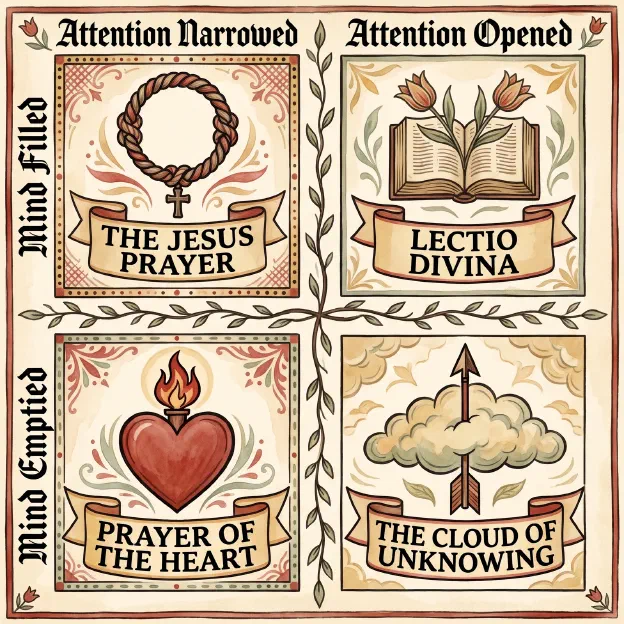
Lectio divina: filling and opening
Lectio divina, a Latin term meaning “divine reading,” is the patient, slow, and prayerful reading of Scripture. It was given its classic four steps by Guigo II, a Carthusian monk of the twelfth century: lectio (reading), meditatio (reflection), oratio (prayer), and contemplatio (resting in God). You read a short passage, notice a word or phrase that stands out to you, then turn that morsel over and over in your heart, answer God in prayer, and finally rest in contemplation.
It starts in the filled corner. The mind has words to work with and is free to range over them. But notice where it ends. The last step is wordless. Lectio divina is a staircase from the filled side of the map down into the emptied side, all within a single sitting.
I highly recommend the book Too Deep for Words by Thelma Hall for an in-depth treatment of this practice.
See also: Lectio Divina Guidelines PDF, Contemplative Outreach
The Jesus Prayer: filling and narrowing
The Jesus Prayer comes from the Eastern Orthodox monks, sometimes termed Hesychasts, from the Greek word for the stillness that characterizes their practice. It is one short sentence, “Lord Jesus Christ, Son of God, have mercy on me, a sinner,” repeated slowly, again and again. The mind is filled, but only with those few words, and the attention is held on them.
Kallistos Ware, the great English teacher of this prayer, describes how the Hesychasts sometimes paced the words with the breath. He is firm that this is secondary. The breathing technique is “no more than an accessory,” and the essential thing is “the inner and secret Invocation of the Lord Jesus.” He quotes a nineteenth-century Russian bishop, Ignatii Brianchaninov, who says that what really helps is “the unhurried enunciation of the Prayer” and “the enclosure of the mind in the words of the Prayer.”
Read that phrase again with Powwow in mind: the enclosure of the mind in the words. That is what a charm asks of us, and what Robert means when he writes that he “recited the charm like my life depended on it.”
A classic introduction to the Jesus Prayer is The Way of a Pilgrim
The Cloud of Unknowing and Centering Prayer: emptying and opening
The great English text of the emptied way is The Cloud of Unknowing, written in the fourteenth century by an anonymous monk for a young monk. Its teaching rests on a single image: between you and God there is a cloud of unknowing, which no amount of thinking will ever see through. Beneath you, you are to put a cloud of forgetting, and let everything else sink under it: worries, plans, even good and holy thoughts. “The more you have in your mind that is not God,” the author writes, “the further you are from him.” What reaches God through the darkness is love, not thinking. “He can be loved, but not thought,” the author says, and so:
Then beat on that thick cloud of unknowing with the sharp arrow of longing and never stop loving, no matter what comes your way.
— The Cloud of Unknowing, ch. 6, trans. Carmen Acevedo Butcher
To keep that love from scattering, the author gives a practical tool. “Select a little word of one syllable, not two,” he writes. “God or love works well.” You “fasten it to your heart,” and whenever a thought interrupts to ask what you want, you “answer with this one word.” The word does not have to be analyzed or understood, only held. “This word will protect you. It will be your shield and spear, whether you ride out into peace or conflict.”
Centering Prayer is a modern revival of that method, taught today by Contemplative Outreach. You sit, choose a short sacred word, and gently introduce it “as the symbol of your intention to consent to God’s presence and action within.” When you start to get distracted or notice that you have become caught up in thoughts, you return “ever-so-gently” to the sacred word.
The word here is not something to concentrate on. It is a sign of consent, a way of saying yes to God again whenever the mind drifts. The prayer itself is receptive and open, and as empty of content as a person can manage.
My own favorite book about Centering Prayer is Open Mind, Open Heart by Thomas Keating.
See also: Centering Prayer Guidelines PDF, Contemplative Outreach
Kelpius’s prayer of the heart: emptying and narrowing
The last corner belongs to one of our own. Johannes Kelpius, the hermit of the Wissahickon whom I quoted in the first post, describes a prayer that begins with two short exercises. First, you call to mind that God “is in her, as well as in the Place where she is, and in all Places, truly present.” Second, you commit yourself “into his fatherly Hands” and resolve to dedicate everything you are “to his most holy Will.” Then you stop working:
When this is done, then the Soul has no more to do the whole time of Prayer but to remain in Peace and Silence; endeavouring to continue in this loving Remembrance of God, who is so truly present in her, as He is in Heaven.
— Johannes Kelpius, A Short, Easy, and Comprehensive Method of Prayer (1761)
The mind is emptied. Kelpius wants it free “from all Figures and Images.” But the attention is not scattered. It is gathered into one thing, the “Inclination of the Heart to God.” His image for how this works is lovely: “Thus it is necessary in the Beginning to kindle the Fire by Working; but afterwards, when once it is kindled, to let it burn.”
Where the powwower sits on this map
A Powwow working sits firmly in one corner. The charm is fixed words, said with care, with the whole attention gathered into them. That is the filled and narrowed corner, the corner of the Jesus Prayer.
But the daily practice that supports the work can come from anywhere on the map, and I think it is healthy to move around it. Lectio divina teaches us to hear Scripture in a deep and personal way. Centering Prayer and Kelpius’s method teach us to set ourselves down and consent to God’s will, which is the heart of everything I said in the first post. The Jesus Prayer trains exactly the attention a charm needs.
Kelpius himself points to the simplest place to start. You do not need any method at all if you have the Lord’s Prayer, the same prayer Robert says over the name of a sick person:
Every Petition of it contains so much, that one may perform a good long ardent Contemplation on it: but when these Petitions are repeated, and we penetrate into them livingly, or ruminate on them in our Hearts, it has a quite different Effect than when they are uttered with the Mouth only.
— Johannes Kelpius, A Short, Easy, and Comprehensive Method of Prayer (1761)
The wakeful mind
Look at the form of the work itself. The patient sits in the chair, and the doctor speaks the words, makes the sign of the cross, and attends to the person in front of them. The words have to be said correctly, which takes a clear head. The doctor is awake, present, and listening.
Robert describes that listening in his post on whether powwowers are psychic, and he is careful about where the credit goes:
God does speak to me; most especially when I'm doing a reading for a client. God speaks through me and I've never had a client tell me my readings were wrong. But all praise, honor, and glory go to God.
— Robert Phoenix, “Are Powwows Psychic?” (2023)
That is a person who stays present, listens, and gives the glory away.
The Christian contemplatives describe their own practice the same way. Even at its deepest, contemplative prayer is alert. The Catechism calls it “a gaze of faith fixed on Jesus, an attentiveness to the Word of God, a silent love” (§2724). The Hesychasts’ word for the state they were after was nepsis, which means watchfulness or sobriety, the alertness of a guard at the door. And Kelpius, for all his talk of silence, says the soul is never more active than when it rests in God:
We ought not to believe, that such a State of inward Silence is Indolence or Loss of Time; by no means: on the contrary, the Soul is then more active than ever, since she is practising Faith, Hope and Love.
— Johannes Kelpius, A Short, Easy, and Comprehensive Method of Prayer (1761)
The meditation that feeds the work makes you more awake. It quiets the noise so that you are more present to God and to the person in the chair.
Its fruit is quiet, too. Robert writes that being powwowed usually brings “a sense of peace that your issue is now in God’s hands” (post-84). The same peace is what to look for in your own practice: a settled heart, and your attention resting on God.
Where to begin, today
Pick one corner of the map and try it for a week. If you are drawn to making reading a part of your meditation, or want to learn an interesting new way to examine charms, try lectio divina with a short Gospel passage. If you are drawn to silence, try Kelpius’s two exercises: call to mind that God is present, hand yourself over to His will, and then simply rest there for five minutes.
Meditation does not have to stay in its own quiet corner of the day, either. Theophan the Recluse, the nineteenth-century Russian bishop who spent his last decades in seclusion writing letters of spiritual counsel, taught people to carry prayer into everything they do. His counsel for the start of the day is simple: “After waking, enter within yourself, stand enclosed in the heart.” Or, “still more briefly: collect yourself and make secret prayer in your heart.” Through the day, he recommends crying out to God in a few words, “according to need and the work of the day”:
Beginning anything, for example, say “Bless, O Lord!” When you finish something, say, “Glory to Thee, O Lord”, and not only with your lips, but with feeling in your heart.
— Theophan the Recluse, “Mental Prayer,” Homily 2, trans. Michael van Opstall
Over time, he says, “such increased frequency will bring about the habit of mental conversation with God.” That habit makes a good companion to the work.
Start simple and keep your sessions short. Ware’s advice to a beginner without a teacher is to keep “simply to the actual recitation of the Jesus Prayer,” and that serves all of us. The Lord’s Prayer said slowly is another good place to return to. I’ll come back to the breath later in this series.
Whichever you choose, notice afterward whether you feel more awake and more at peace. That is the fruit to look for, and it’s what you will share with a patient.
May God bless the work of your hands, and the work of your mind.
✠ ✠ ✠
Arthur
Sources
- Catechism of the Catholic Church, §§2705, 2708 (text) and §2724 (text).
- Guigo II, The Ladder of Monks (Scala Claustralium), c. 1150, for the four steps of lectio divina.
- Thelma Hall, Too Deep for Words
- The Way of a Pilgrim
- Kallistos Ware, “Jesus Prayer – Breathing Exercises”, quoting Ignatii Brianchaninov (1807–67).
- The Cloud of Unknowing (14th century), trans. Carmen Acevedo Butcher, The Cloud of Unknowing: A New Translation (Shambhala, 2009), chs. 5–7.
- Igumen Chariton of Valamo, comp., The Art of Prayer: An Orthodox Anthology, trans. E. Kadloubovsky and E. M. Palmer (Faber and Faber, 1966), p. 79, for Theophan on secret prayer in the heart.
- Theophan the Recluse, “Mental Prayer,” Homily 2, trans. Michael van Opstall (2007).
- Contemplative Outreach, “The Method of Centering Prayer”.
- Thomas Keating, Open Mind, Open Heart (1986).
- Johannes Kelpius (attr.), A Short, Easy, and Comprehensive Method of Prayer (Philadelphia, 1761); modern edition: Kirby Don Richards, A Method of Prayer: A Mystical Pamphlet from Colonial America.
- Robert Phoenix, “Are Powwows Psychic?” (2023); “What does Powwow ‘FEEL’ like?” (2023).