Making the Prologue Sheet
This is the fifth post in my series on Robert Ambelain’s Sacramentaire du Rose + Croix ([1964]). So far I’ve given blessings: the salt, the taper, the Water of Exorcism, and a book. This one is a little different. It isn’t a prayer but a thing to make: a sheet with the opening of St. John’s Gospel written on it by hand, which sits at the center of the altar.
The Gospel of John is at the heart of this tradition. By custom, upon the altar in the temple space where a Rose + Croix d’Orient (RCO) initiate would work is a cloth of golden-yellow silk with the Gospel of John laid on it, open to the first chapter, between two beeswax candles. Ambelain explains where the custom comes from. At Byzantium, the emperor had at his right hand a richly ornamented seat, and on it was laid, half unrolled, the parchment on which the Gospel according to St. John was copied, with a lit flambeau upon the Gospel itself. Together they stood for Christ, invisible but present. The Prologue sheet carries on that use. The Gospel is not only read at the altar but honored there, as the sign of the presence of Christ.
My own “parchment” was made for me by my wife’s mother:
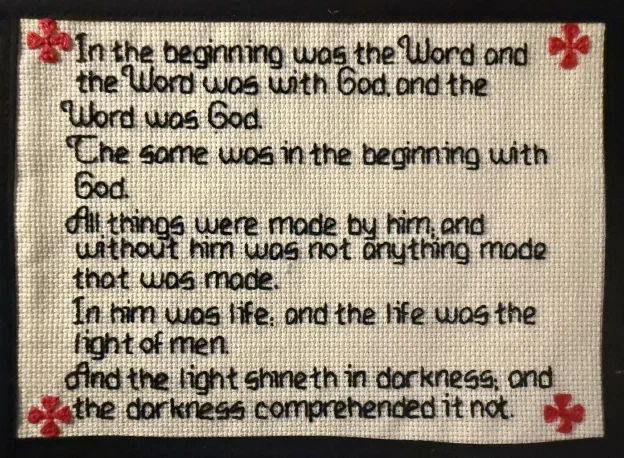
You don’t need the whole temple setup. I believe the sacralizations work without it, and without initiation, but the sheet makes a temple space wherever you are, and small touches like it or a beeswax candle lend the operations their traditional air.
Making the Prologue Sheet
From the Rose + Croix d’Orient altar instructions (OKRC, 1st version, the ritual of Kloppel), pp. 4–6.
Materials. A sheet of parchment, a new pen, and a new small bottle of black India ink. The pen and the ink are used for this and nothing else, and you throw them away when you’re done.
The layout. The instructions give no written steps for the layout, only a picture of the finished sheet. It shows a heavy black border, an ornamented cross in each of the four corners, and in the center the first five verses of the Gospel of John in Latin, in a gothic letter:
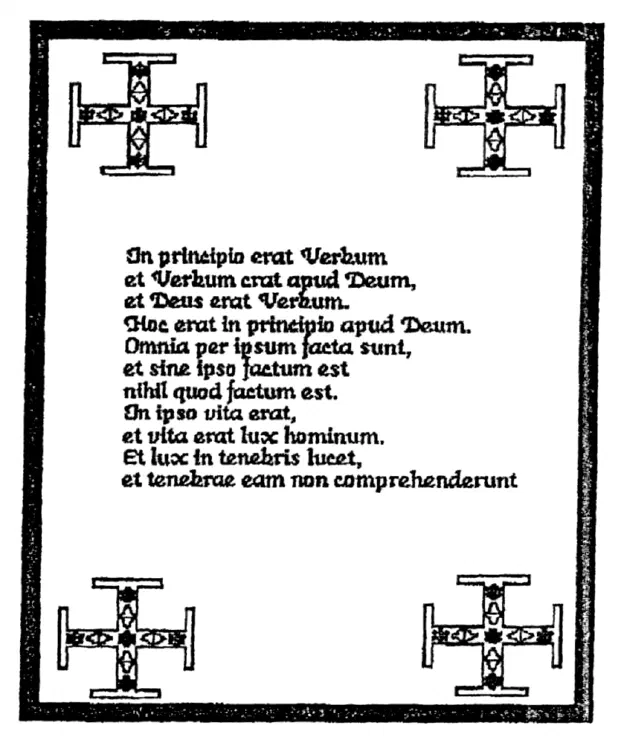
In principio erat Verbum,
et Verbum erat apud Deum,
et Deus erat Verbum.
Hoc erat in principio apud Deum.
Omnia per ipsum facta sunt,
et sine ipso factum est nihil quod factum est.
In ipso vita erat,
et vita erat lux hominum.
Et lux in tenebris lucet,
et tenebrae eam non comprehenderunt.
In the beginning was the Word, and the Word was with God, and the Word was God. The same was in the beginning with God. All things were made by him: and without him was made nothing that was made. In him was life, and the life was the light of men. And the light shineth in darkness, and the darkness did not comprehend it. (John 1:1–5, Douay-Rheims)
On an RCO initiate’s altar. The altar is covered with a yellow cloth, of silk if possible. The Prologue sheet goes in the center. To its left lies a New Testament, bought new for this work, open to the Gospel of John, with a copper dagger laid across it, pointing to the North. Above the sheet go burning incense, the crucifix, and the Sacramentaire. A beeswax candle is set at each of the two lower corners. As they are lit, the operator says:
In nomine Patris et Filii et Spiritus Sancti.
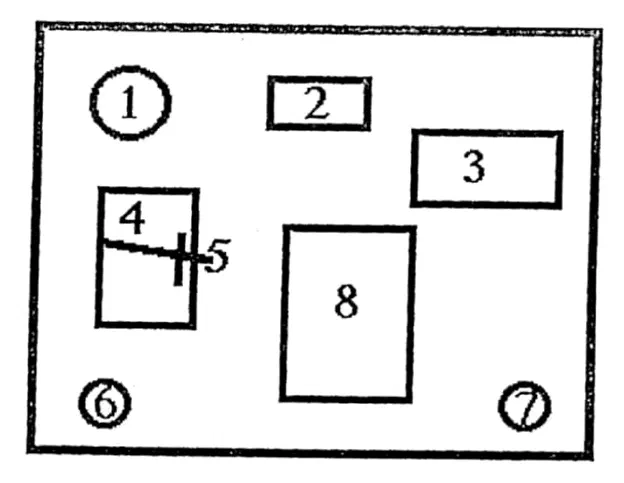
In use. In the traditional ritual context, every working begins with the Prologue read aloud. I recommend this for RCO operations, even outside the full ritual that initiates use. Unless you’ve been initiated into the RCO, this is a respectful emulation adapted to the shape of your own practice.
A note on the English versions: Phillip Garver’s translation (2003) says the dagger is “of leather.” The French says copper (de cuivre).
May God bless you.
✠ ✠ ✠
Arthur