The Powwow Guy
Home of Robert Phoenix and Traditional Christian Pennsylvania German Powwow
Blog
Even though this entire website is technically my "blog", this page will hold my extra articles that don't really fit in well on the other pages, or maybe there will just be ideas that jumped into my head that I wanted to share here. Some of the older blog entries are helpful and so I recommend you scroll down and look through the entries from 10 years ago or so...
The almanac and its place in PA German culture
|
|
Pennsylvania German culture is rich with folklore and quaint folksy traditions. One of the more popular traditions that has spanned well over 400 years is the use of the Farmers Almanac.
The Almanac has been a household friend since the earliest arrival of German-speaking immigrants to the Commonwealth. We as a people rely on the almanac for weather forecasts, moon lore, planting and harvesting days, as well as other numerous items as laid out by Julius F. Sachse in a 1907 essay titled "Porgnostics and Superstitions":
The Aberglaube (superstitions) of the early Germans may be said to have been divided into at least a hundred different forms, the scale running all the way from a simple belief in the efficiency of Bible verses promiscuously selected down to demonology itself. Perhaps the most common of these superstitions was what was known as Kalender-Aberglaube, or a belief in prognostics based upon the almanac. This was again subdivided into various departments, based upon the phases of the moon and other celestial bodies. This, however, is not to be confounded with the custom of astrology or the casting of the horoscope. To any person schooled in the art, the almanac became the guide and mentor for almost every function of daily life. First, it told us of the state of the weather for every day of the coming year; then it informed us what were to be the prevalent diseases, gave us the proper days for felling timber, taking purgative medicine, for bleeding and blood-letting, for cutting the hair, for weaning calves, children, etc. It gave the lucky days for sowing grain, the proper days for a merchant to speculate, and for other daily avocations.
I consult the almanac weekly for weather, planting, harvesting, and other advice as one might need with a large property and animals and plants to tend to. There are extra bonus articles that can give you all sorts of advice, ranging from the best time of day to catch fish to how to properly install a fence post! Truly, the almanac is the best friend you can ever have!
Consider this by poet Mark Louden...
Mark L. Louden reciting “Mother’s Almanac”
“Mother’s Almanac”
Faith has much to do
With our human life;
The lawyer believes in big pay,
The minister believes in praying;
The young girls get a lot of joy
From their faith in men;
Mother takes the good old way,
And believes in the almanac.
Sie always observes the signs,
Before we dig the garden;
And goes by the moon, you can bet on it,
For that is her faith.
In order to grow well, everything must go in
During the waxing of the moon;
Thus she plants in that sign,
As others do, as well.
Potatoes you plant in Libra,
Then they get nice and big;
You might think that’s a joke,
But I’m not so narrow-minded.
That’s why I wish they would not slip
Down so deep into the ground,
And if there were no such sign,
They would not be so round.
So if you don’t watch the sign,
Just as it is in the almanac,
Then your potatoes will be ruined,
And we’ll have nothing to sell;
I tell you now, don’t plant in Cancer—
They crawl down too deep,
And get as warty as a toad
And also taste bad.
Cucumbers, really, you may not
Plant in the sign of Gemini,
Otherwise they just go ahead and bloom
And creep around like roaches;
That sign is not for a good crop,
They just don’t form on the vine—
Whoever wants cucumbers, doesn’t plant
In the sign of Gemini.
But now, whoever likes flowers,
This sign is the best;
The blossoming virgin is also good
For planting flowers.
In spring here, in Virgo, that is,
You let the hens out,
Whoever goes by this sign then gets
Better chicks from them.
When bees swarm in Libra,
Honey becomes plentiful in the hive;
If a cat drowns in a water trough,
At least it won’t die of thirst.
When fruit trees are in full bloom
While the moon waxes, there’ll be fruit;
But if the trees blossom during the waning,
There’s not much you can do.
In the setting moon you roof a house,
That keeps the shingles down;
And whoever doesn’t build according to the almanac,
His shingles will be down right away.
To roof during the waxing of the moon,
That’s the wrong thing;
The shingles curl right up,
And you get a ragged roof.
You make the post fence according to the moon,
But just when it is setting;
The posts will not stay in the ground
In any other sign.
So, don’t laugh, and take heed,
I’ll tell you that in advance,—
Whoever makes fence in the waxing of the moon,
His posts will creep out.
Some poke fun, there are such people,
Especially among the menfolk,
Yet they are in no way as smart
As Mother’s almanac.
“An old wives’ tale, ha!”
That’s what they always say,
But faith will still save,
And it rules digging in the garden.
Libra is supposed to be good for planting,
But some also put in potatoes
In the Aries waxing moon,
That’s just testing.
And for good luck with radishes
Seeds have to be planted in Pisces,
That means that radishes will be tender and thick
And plenty on the table.
In the fall apples have to be put away,
And so that they don’t rot
You have to do this in the dark moon, you bet,
Even if the men-folk complain.
To get vinegar you need to tap the cider
In the sign of Leo, definitely:
That makes you as strong as ginger pop,
And as crusty as an old grouch.
But winter meat should not be
Hung up in the sign of Leo,
Otherwise it will get as “lively” as a lion—
One definitely wouldn’t think that!
White worms will move right in,
If no one goes fishing,
That way you get fresh meat, too,
If you don’t understand the sign.
A board left out in the weather
Often gets quite warped,
But one doesn’t consider the reason
As being the influence of the moon;
In the waxing of the moon the board turns up,
In the waning down,—
It all depends how the moon shines on it.
Isn’t that amazing?
You don’t clean your house in a full moon,
That’s the wives’ tale,
For if you do, the house will fill up
Terribly with moths;
That just goes to show, moths go
By the moon sign in the almanac,
Apparently they are sharper
Than our clever menfolk.
The signs have the world in order,—
Capricorn, Pisces, and Aries,
Leo, Libra, Aquarius,
Taurus, he’ll knock you down;
Sagittarius, he shoots, Aquarius pours,
We have Cancer and Gemini,
Scorpio stings, Virgo speaks,
That’s how you find it in the almanac.
Gifts and favors - the sign of a true witch
|
|
Here in Pennsylvania we have no shortage of stories of farmers and house maids having unfortunate run-ins with the local witch. Many of the stories begin innocently enough.... a farmer accepts a gift from a mysterious stranger... a new mother is visited by a vengeance seeker... a simple land dispute becomes a battle between good and evil...
Throughout our history, many instances of innocents becoming verhexed begin with the receiving of a gift. That gift might be something tangible, like a broom or a pitcher of milk. Or it might be something seemingly innocuous, like a kiss on the cheek or a whispered word...

There is a superstition in Pennsylvania German culture that to accept a gift unearned is to invite bad luck. And we never, ever pick up anything found on the street! To be offered a gift unwarranted is a good way to welcome witchcraft into your home. Even amongst powwowers, where there was a lot of rivalry, the giving of gifts was often a nefarious practice! The gift itself was basically the cover for a malevolent verhexing.
When a curse is removed and returned to the sending witch, a sure way to know you've targeted the right person is to wait for them to come to you with a request to borrow something. If that individual does show up at your door in need of something (no matter how trivial), we are smart enough to refuse them this request! What is really happening is the witch can feel her/his power over you diminishing and requires something that belongs to you in order to solidify their stranglehold over you. Without that object, they are powerless.
I've received a few "gifts" over the years, many of which are indeed sincere and I'm always appreciative. However, there are a few that I just knew weren't sincere. They are safely out of harm's way in the Susquehanna River, never to realize their evil potential.

If you do receive such a gift, be sure to dispose of it either by burying it six feet into the ground or weighing it down and dropping into the deepest part of a river or lake that you can find. And if a suspected witch comes to you in need of borrowing an object, politely say no and give her no further foothold in your life!
The magical boundary
|
|
As a Powwow, the protection of my home and my property are paramount to my successful healing work. Should something unwanted cross the boundary into my personal space, it could negatively impact my health, my family's health and safety, and the efficacy of the work that I do. In order to ensure that I am protected at all times, I use my Powwow knowledge to create a magical boundary around my home so that I am always assured of magical privacy and protection.

A magical boundary is exactly what it sounds like; a barrier placed between your space and the rest of the world in order to live your life and work your Powwow without outside interference.
The Powwow tradition offers a number of methods for creating a magical boundary. The most well-known and, in my opinion, the most effective, is as follows:
To manufacture a Golden Ring, by which not only House and Home, but also Man and Beast are secured against all Misfortunes, Pestilential Epidemics and Diseases, and are secured against the Arts and Wiles of the Powers of the Devil.
May God direct and rule, that this hour, day and year and all the time may be as good and blessed as our dear Lord Jesus Christ; that grant God, the Father, and God the Son, and God the Holy Spirit. Amen.
May God, the Father, make a golden ring around this house, around this stable, around all men and beasts that belongeth thereto and goeth in and out of it; also around my fields and forests, yea, this very ring encircles our beloved Mary with her dear infant, Jesus Christ they protect, watch over, maintain, shelter, cover and defend all mankind, both male and female, small and large, young and old, as likewise, all cattle, oxen, steers, cows and calves, horses and foals, sheep, goats, beef-cattle, and swine, geese, ducks, chickens, pigeons, large and small, whatever is contained in this house and these stables and all that cometh in and goeth out; for all misfortunes, evil, colic wild fire, losses, epidemics, and other diseases; for all bad and heated blood; for all bad and malicious enemies and storms; for all evil hours, day and night; for all magic power of witchcraft, and the designs and powers of the devil and his infernal hosts, to be visible or invisible, or for all wicked people who contemplate to rob me, that they may not be able to carry or spoil aught, anything that these people and animals, young and old, large and small, nothing excepted, whatsoever belongeth to these premises and their surroundings, and goeth out and cometh in, from whence and hence that no loss may occur, nor any evil be done at home or abroad, in the field or in the woods, in the meadows and on the plains, in grass, wood or heath, whether it works or rests, sits, lays, runs, or stands, they shall all now for all time to come be included in this ring, and be secure and protected from bullet and sword, by the very holy blood-drops of the dear beloved infant, Jesus Christ, which he hath suffered and shed for us by his circumcision and upon the cross and thereby vouchsafed and sealed his love everlasting, for such, they, the magicians will find no herb which may open, break or move or pervert, because our dear Lord Jesus Christ, protects and defendeth such with his ever holy hands, and his supremely sacred five wounds, at all times, by day and by night, and at all hours, forever and ever eternally. In the name of God the Father, the Son and the Holy Spirit.
Three Fridays in succession, in the morning, this should be repeated three times over house and all the estates, and all that lives and dwells therein will be protected from all evil and harm.
The real power in a blood-stopping charm
|
|
I have spent several years working to "decode" certain charms that are found within Long Lost Friend, Albertus Magnus, and a few other sources, in an effort to uncover any hidden symbolisms or meanings. In some instances, I was alarmed by what I had found because it made me realize how much actual POWER there is in the tradition. It shocked me the first time I was able to work a charm with the true understanding of it's meaning and the power that it conjured.
Recently, I decided to start unraveling the mysteries of the blood-stopping charms. Here's one from Egyptian Secrets that you might be familiar with:
To Stop the Blood
Three roses upon God's acre stood -- the one is called humility, the other gentleness, the third stops the blood. + + +
At first glance, you might find yourself visualizing three roses growing on a lovely patch of God's green earth... And two of those roses have a name, and the third has the power to stop the flow of blood.
But let's look closer.
"God's acre" comes from the German Gottesacker (field of God). This doesn't mean just any old field, it means a churchyard. In particular, a graveyard just outside of a church. So this charm doesn't actually call on a lovely sunny field of earth, it calls up the image of a graveyard. This phrase is particularly common amongst the Moravian church, which is headquartered here in Bethlehem, Pennsylvania.
The three roses are a recurring motif in Powwow charms due to the number 3's association with the Holy Trinity.
The names of the roses are where we begin to decode this charm.
"the one is called humility, the other gentleness, the third stops the blood." As you can see, only the first two are given names. The name of the third rose is not revealed, although this rose is stated to "stop the blood". But what is the third rose's name?
For that, we go to Ephesians 4:2 "Be completely humble and gentle; be patient, bearing with one another in love."
"bearing with one another in love." Roses are historically symbols of love.
The name of the third rose is PATIENCE. And so the word PATIENCE is the true word of power in this charm.
When working for this charm, you will repeat it three times, as stated. But you would also silently utter the word "patience" over the bleeding wound. The charm literally states that it is this specific rose that will stop the blood. The rose of patience.
With the mental imagery of a graveyard, we can understand that patience is necessary in order to wait for ever-lasting life. When we are all called into heaven at the End of Days, our patience will be rewarded. I believe this understanding while working this charm is crucial to it's success. As is true with all of the Powwow charms I've "decoded", what you see at face value is very different than what is truly at work. And a deeper understanding of the mysteries of these charms adds so much power to your work.
Magical oddities in Powwow
|
|
The Powwow tradition is no stranger to odd and unusual charms. Indeed, we Powwows are often judged harshly when a non-practitioner (ie. someone who doesn't understand) gets ahold of one of our books and reads a few of our more obscure formulas and rituals. However, our tradition is much like any other folk tradition in that it has a healthy balance of approachable healing techniques and spells that are best kept secret...
Whether those oddities in the Powwow tradition are for healing a common ailment, aiding in childbirth, giving you luck with a fishing rod, or taking the power from a rival Powwower, you can be sure that, if nothing else, the methods make for great discussion about the potential us Powwowers have of practicing odd and weird rituals to get what we need.
To Cure Gout
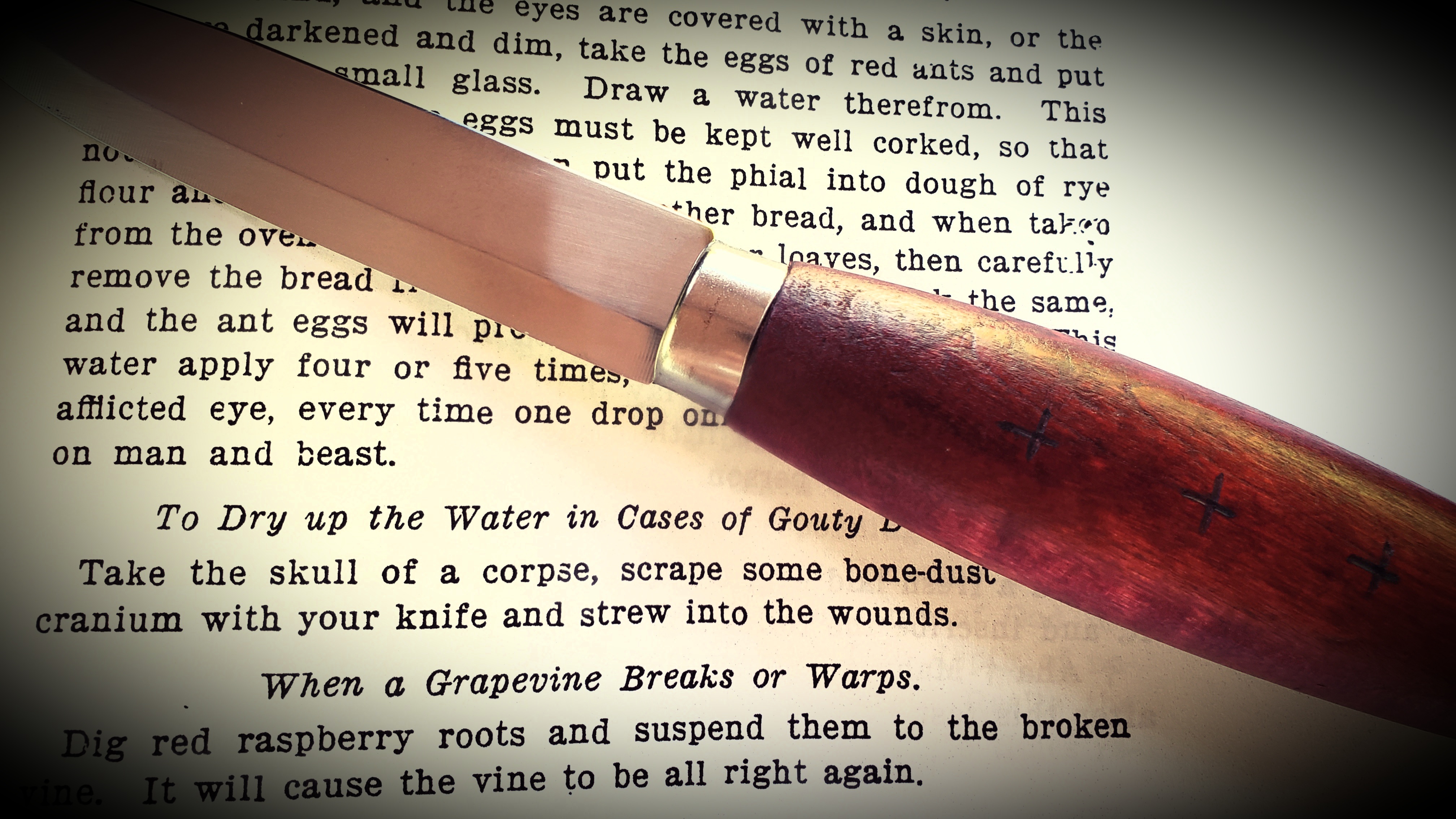
Gout is a painful and sudden onset condition when uric acid builds up in one particular place in your body, often a joint. It is characterized by intense pain, redness of the area, inflammation, etc. Typically, an over-the-counter anti-inflammatory drug will help relieve the symptoms. But back in the day, we didn't have access to ibuprofen. So instead, us Powwowers used a knife and a human skull.
When that pesky Hexenmeister down the road is stealing your clients...
No one likes that. You set up shop, you build your reputation, you get a nice group of regulars coming to you for healing, and it's a really good arrangement. But then Jebodiah Stoltzfus, the county Hexenmeister, moves into the old farm house down the road. Now you've got no one to Powwow for and people don't even stop by for your homemade elderberry syrup. What's a Hex Man to do?
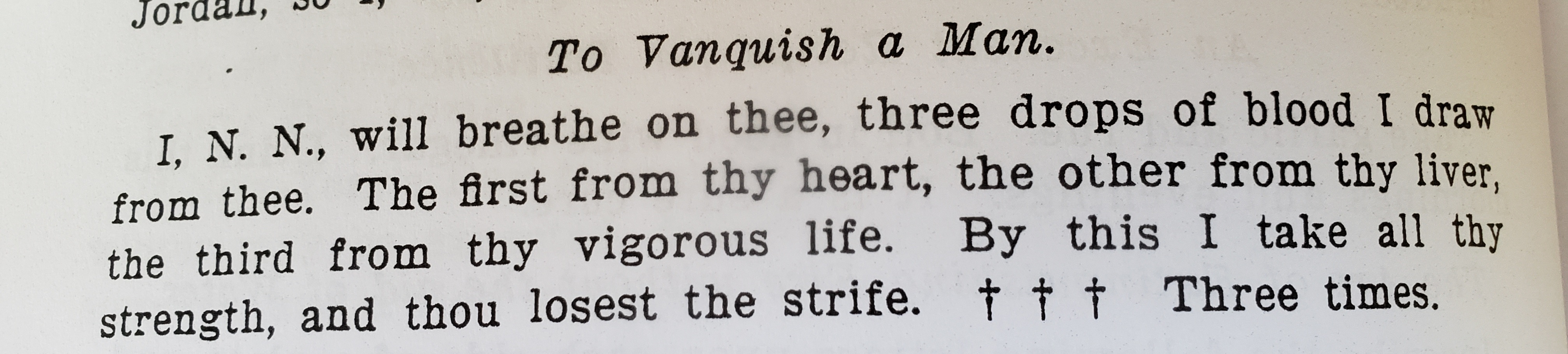
A ritual like this might involve the use of your trusty knife, and maybe a heart, liver, and testicles (yep, I said it) from a cow, horse, deer, or bull (whatever you can get...the butchers will sell you anything for a good price). If you're gonna do this type of work, be ready to get your hands bloody and make sure your soul is in good standing with the Lord, because this isn't pretty stuff.
When a cow loses her milk (presumably by witchcraft)
Back in the day, if a cow was sick, that could mean serious financial loss to a family, not to mention lack of milk for the day. The Powwow tradition is heavy with charms for healing sick animals. And as was common in the 16 and 1700's, sudden animal illness was often seen as a sign of witchery. So the healing charms often include a rider about harming the witch who caused the illness.
This charm is so complicated and involved that I question whether anyone has actually ever attempted it. Certainly I have not. However, it's fascinating to me simply because it does have so many steps to it. Many practitioners of magic will often say that the preparation of the work is just as important and powerful as the performance of the work. With charms like the following, I imagine it would be tricky to stay focused on the task at hand..
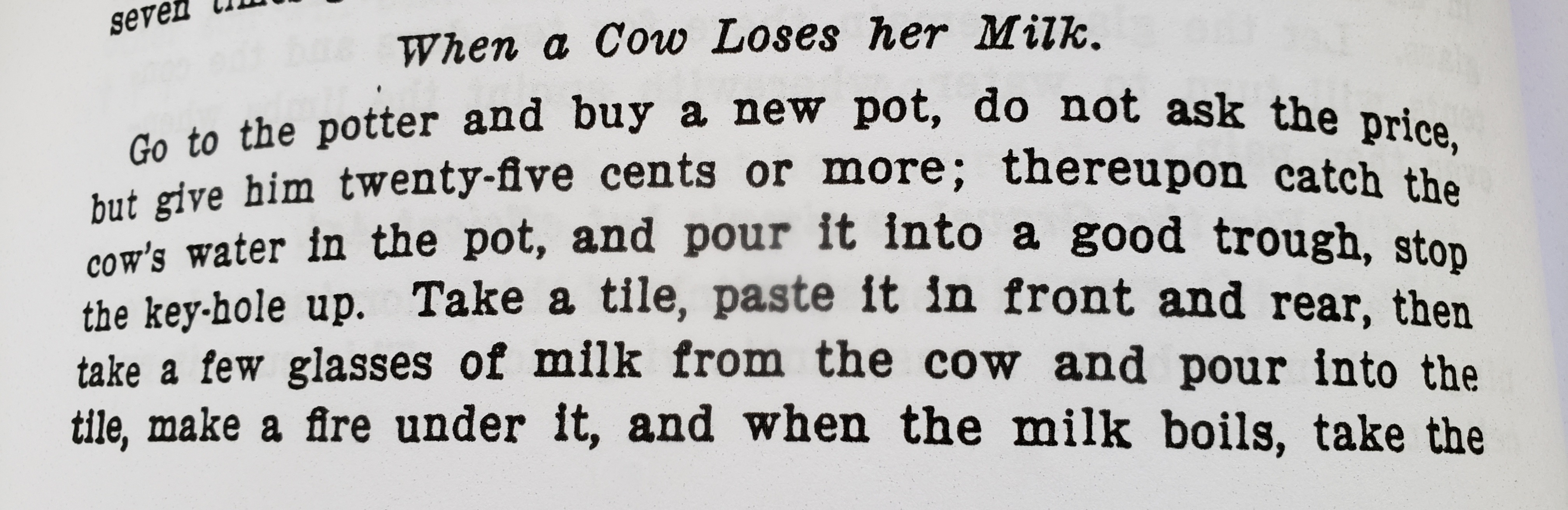
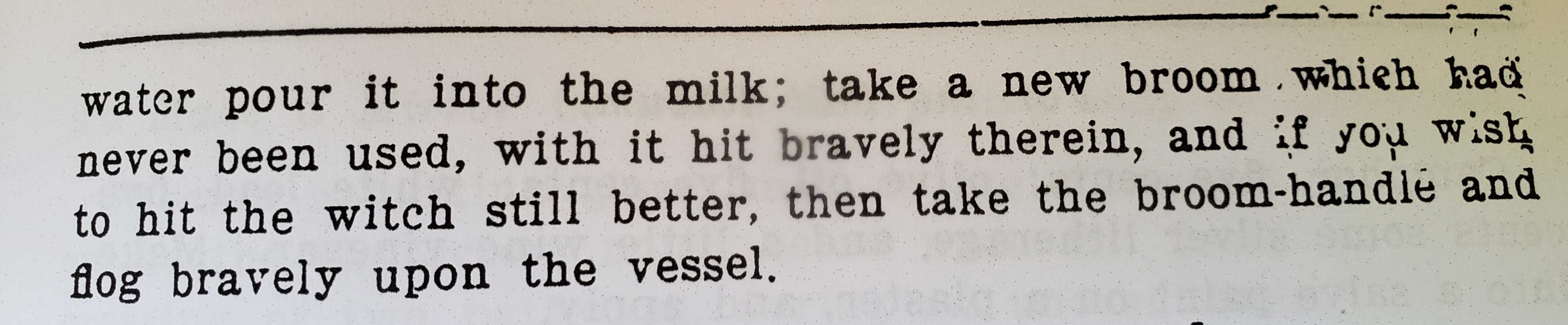
While this particular blog post was written in a light-hearted spirit of having fun, make no mistake! Powwow is a very serious tradition with some pretty powerful magic involved. Never underestimate your local Powwow or our ability to do whatever it is we must do in order to survive in the world.
+ + +
Powwow in the garden
|
|
Bill and I have many flower gardens on our property. I also have a large vegetable garden and I grow herbs in pots on one of the patios. This year, I added a few herbs to the actual garden because they were growing so large they could no longer fit in the pots. 2020 was a bad year for the veggies and herbs (and life in general) but this year things are growing with a vengeance, and I'm really excited to see our stuff growing!
As a Powwow, my connection to my property is extremely important to me. I feel great pride and happiness when my land is doing well and the life is flourishing. I mourn the loss of plants or animals on our property and I celebrate when things are growing healthy and strong. I say prayers for my plants and add blessings to the vegetable garden and read bible verses to my herbs. This is how I incorporate my spirituality and my Powwow into the work I do here at home.
I know my vegetable garden doesn't look like much right now, but in a few weeks it will be lush and full.

My potted herbs are doing very well this year. Herbs are tricky for me. Sometimes they grow, and other years they are more stubborn.

As a folk healer, I think it's extremely important to care for our land just as we care for our clients. When we can love our plants and our native flora and fauna, we can also learn to love and respect those who come to us for healing. Many people have commented on how peaceful and lovely it is to spend time on my property, and I hope they carry that feeling with them. I do believe it adds to the healing process. And I always recommend to my clients that they start a garden if they are able to do so. There is so much healing power in connecting with your land, cultivating your gardens, and creating a beautiful and spiritual place of healing.
The Roadside Apothecary
|
|
Yesterday I wrote a blog post about finding Stickyweed (Sticky Willy) on the side of the road near my house. This morning I walked back up to that hillside to check out what other treasures I might find, and I was NOT disappointed!
Here is a picture of the hill (upper left hand side of the picture with the house and barn-like shed on top). The view is from the bar on my patio.
.jpg)

So far, I've come away with Creeping Charlie, which is extremely beneficial in fighting against lung issues, sinusitis, and ear/nose/throat illnesses. I found garlic mustard, which is primarily an antiseptic. I found Dead Nettle (purple nettle), which is astringent and anti-inflammatory. I found Speedwell, which is an expectorant but can also relieve stomach upsets. In addition, I found dandelion and plantain, which are good blood cleansers. I also found yellow mustard seed which is anti-inflammatory and a good pain reliever. There are a bunch of other plants that I cannot yet identify.

Your neighborhood can be a veritable pharmacy of herbs and plants. Many of these grow like weeds and are generally treated as such. The hill where I found most of these is technically my neighbor's property, and once or twice a year they take a weed trimmer and hack it all to the ground. Now that I can idenitfy the benefits to many of these plants, I will do my best to harvest them before they go all scorched earth.

Take a walk around your neighborhood. Pay attention to what is growing alongside the roads. What may first appear to be normal roadside weeds can actually be powerful healing medicine in the right hands. Powwow teaches us to live with our land, so access to these healing plants is such a God-send for me!
Sticky Willy: a super healer and cocktail mixer
|
|
I love plants and their medicinal and folklore uses. Today as I was walking my dog near my house, I noticed an entire lovely hillside along the road that was positively covered in stickyweed (AKA Sticky Willy)! This is a lovely plant that has a sticky, almost velcro-like quality to it due to the tiny hair like growths along the stem. Sticky Willy grows like a weed and wraps around and climbs on whatever it touches, including itself. It can grow alongside most roads, so it's likely you've seen it or have it near you.

The beauty of this plant is that the leaves can be infused with vodka or gin (clear is best) to give them a lovely cucumber, honeydew, herbal flavor. The stems can be cut up into small bits and added to some water then blended in a blender. Then strain a bit into your cocktail. You can soak the leaves in water for a few hours to use as a facial cleanser. Folklore states it will make you beautiful!
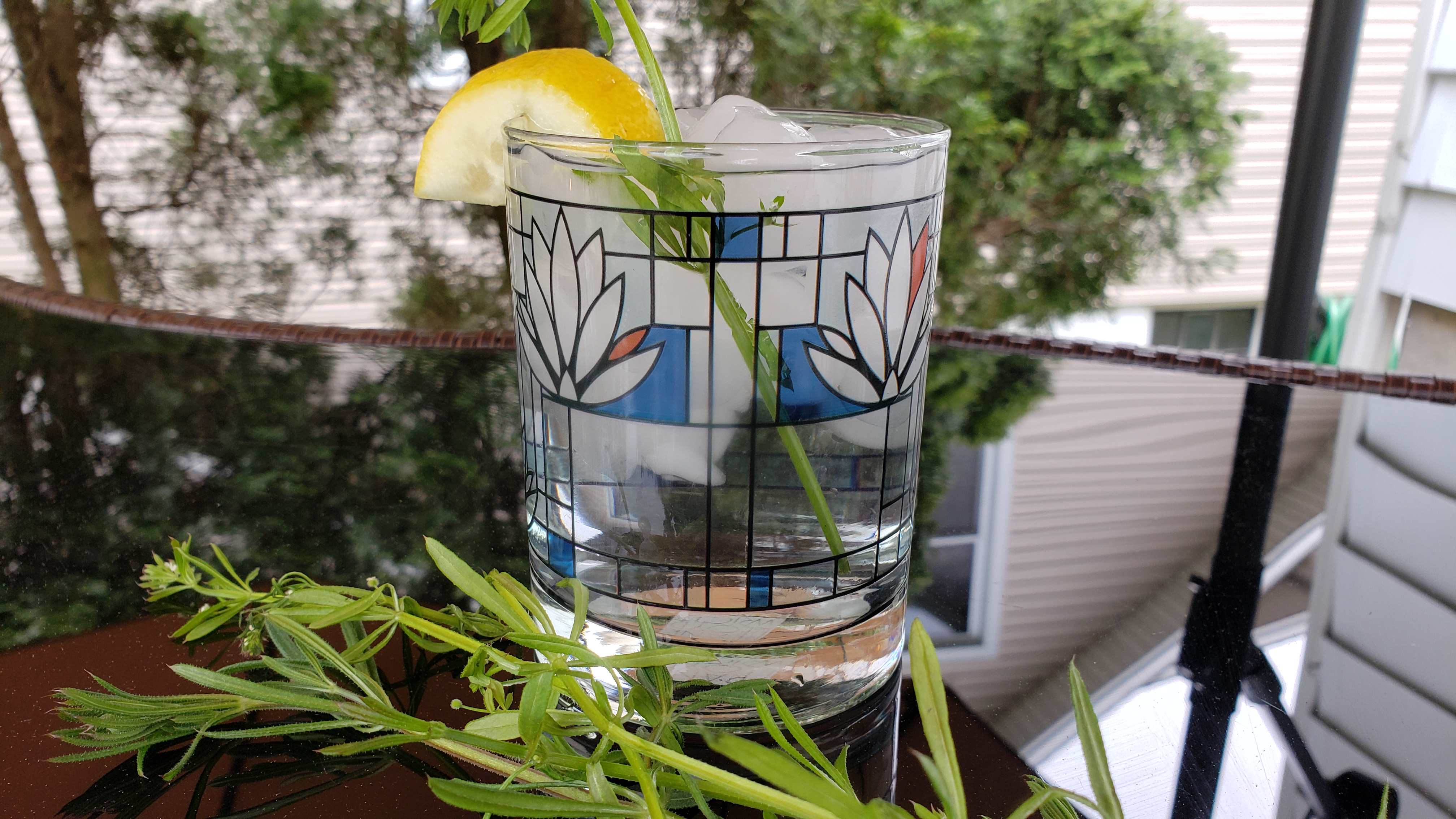
Sticky Willy has powerful antioxidant properties, so the infused water can be drunk when needed. You can make the stems and leaves into a healing poultice for wounds, as well.
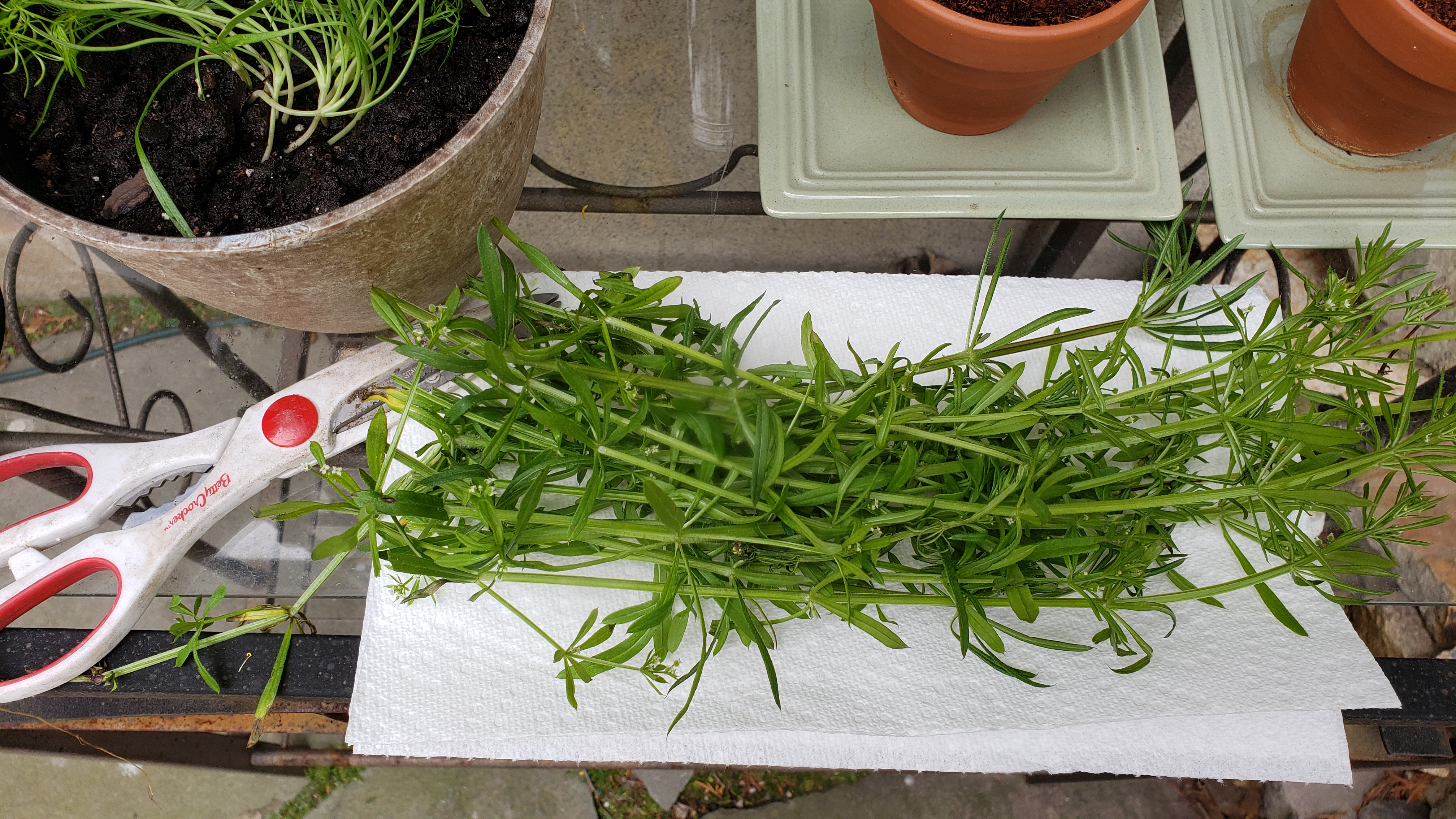
I don't recommend growing Sticky Willy in your garden because it spreads quickly and will make your other plants extremely unhappy. But once you find a local place to cut some, that supply will likely return for many years!
A means of binding one who has wronged you
|
|
In folk magic, to "bind" someone is to cause them to be unable to cause harm or mischief until they are brought to justice. It is a means of bringing down divine intervention upon a criminal so that they are unable to take any type of action; leaving them vulnerable to capture by proper authorities. Imagine the thief being unable to flee....or the murderer to be unable to move from their hiding place... those are the ideas behind the old binding charms.

Such charms can also be used to cause a magically-oriented individual to be unable to take magical action against you. There are various methods within the Powwow tradition to aid in such endeavors, including the use of wormwood, Solomon's Seal, blessed salt, and binding charms like the one found in this blog post.

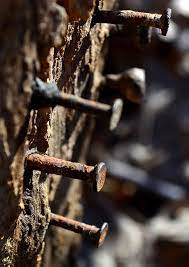
To work a binding charm, often you will need to write the name of the offending person on a slip of paper and nail it to a tree with three iron nails. As you nail each one into the tree, repeat the following:
Ye thieves, I conjure you, to be obedient like Jesus Christ, who obeyed his Heavenly Father unto the cross, and to stand without moving out of my sight, in the name of the Trinity. I command you by the power of God and the incarnation of Jesus Christ, not to move out of my sight, + + + like Jesus Christ was standing on Jordan's stormy banks to be baptized by John. And furthermore, I conjure you, horse and rider, to stand still and not to move out of my sight, like Jesus Christ did stand when he was about to be nailed to the cross to release the fathers of the church from the bonds of hell.. Ye thieves, I bind you with the same bonds with which Jesus our Lord has bound hell; and thus ye shall be bound; + + + and the same words that bind you shall also release you.
You are able to substitute the word "thieves" for whatever is troubling you, such as "bad neighbors", "witches", or whatever.
Once the charm is complete, the only way for the individual to be released is by you. You will remove the nails from the tree while saying three times:
You horseman and footman, whom I here conjured at this time, you may pass on in the name of Jesus Christ, through the word of God and the will of Christ; ride ye on now and pass.
You should only release the individual once justice has been served.
The Farmer and the Hex Man
|
|
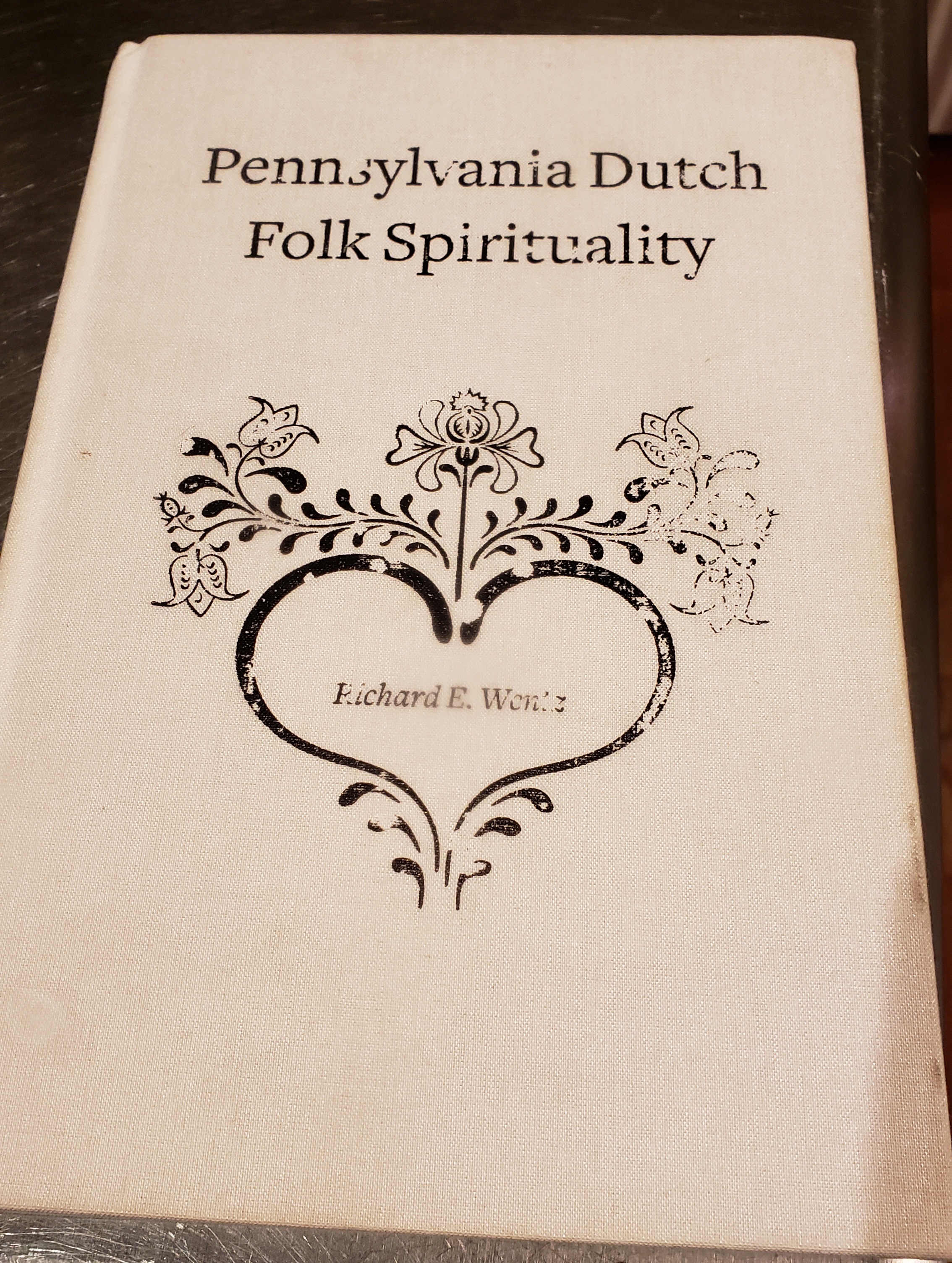
This story is taken from Pennsylvania Dutch Folk Spirituality by Richard E. Wentz, 1993 published by the Pennsylvania German Society. I highly recommend this book! I've added my own commentary after the story....
....In Lebanon county when I was a boy there were two farms side by side where Trout Run slides along under Second Mountain.The richer farm, of course, was in the valley, the poorer up on the side of the mountain. The hill man worked for the valley man at most seasons of the year. They had a disagreement finally, not a very serious one, the valley man thought, but serious enough to make the hill man throw up his job and to refuse to come back to it even after a rather humble visit of his old employer.
Shortly after this, hogs of the valley man sickened and dropped off one by one until six were dead. Meanwhile one of his mules was mired, and broke his leg and had to be shot. A cow died of milk fever after calving. The valley man went over the mountain to consult a famous powwow man in Schuylkill County. The powwower told the valley man that the hill man had bewitched his stock. That was what the valley man had expected to be told, for the hill man had been regarded by some of the neighbors as having certain ways of a "hex". The witch doctor told the valley man that if he went to one of the great wooden uprights in the underground stable of his barn he would find a hole in it with a wooden plug and hair of the pigs and mule and cow behind the plug. He found a hole bored out with an auger, and plugged, of course, and a wad of hair at the back of it. After the removal of the hair no more of the stock died.
The valley man had no more bad luck that winter, but by spring he was so uncomfortable living there under the "hex's" eye, with the water from the "hex's" place running down through his pasture, that he sold out and moved down into the Tulpehocken valley. What really drove him out was the light he saw every night in the hill man's attic. The valley man thought there was magic being made there that would end in more trouble for him and his. Just before the light appeared the hill man had gone to Reading, and on his way back home he had shown at the last tavern a copy of Albertus Magnus. In his cups he had boasted of the great power of witchcraft in the book. Then came the light in the attic window. The richer and stronger and better man thought it the part of discretion to move. That was more than thirty years ago, but the hill man "hex" still lives, and still at night you can see the light in his attic, certainly up to and past twelve o'clock. Neighbors who have sat up to watch it say that sometimes it is not out until three o'clock in the morning...
This story is fascinating to me for several reasons. First, the hill man uses Albertus Magnus to cause misfortune to the farmer. This shows that the same information that powwowers use to heal is also used to verhex. Secondly, it is incredible that the powwow in Schuylkill County was able to see exactly the charm the hill man had used against the farmer and his livestock. And finally, it made me chuckle how the hill man boasted of his "witchcraft" in a tavern, while actually brandishing his copy of Albertus Magnus!
Powwow's history is a colorful one, that's for sure. Sometimes it can be tricky to discern fact from fiction, or history from myth. But part of the mystique of the tradition is the stories such as the one shared here. In some parts of Pennsylvania, Powwow was so revered that the practitioners became legends in their own way...their sagas told as local myths.
I hope you enjoyed this story, I certainly do! PLEASE check out the book as I mentioned above. It is worth your time in tracking down a copy.